


Under the warm spring sun, a patch of kale in the Flower Garden of Xiamen Botanical Garden has become a new "internet sensation." These kale plants, unlike their usual low-growing appearance, stand upright and form small tower-like structures in layers, with the tallest exceeding half a meter in height. Netizens jokingly refer to them as "three-dimensional cabbage."
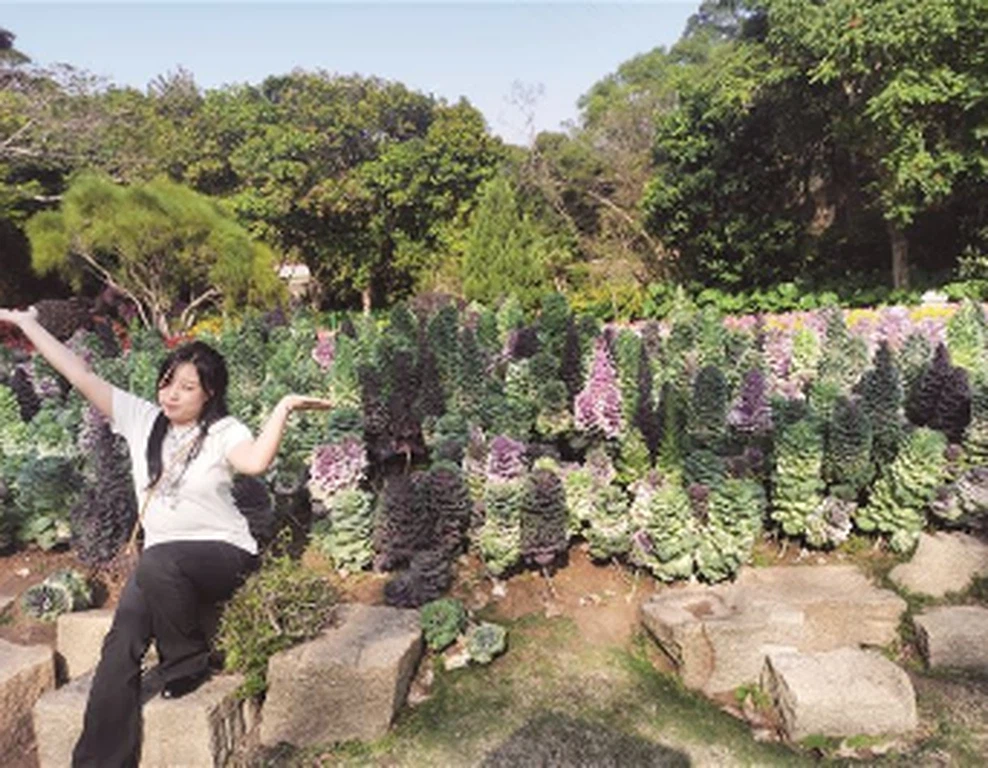
"Come here, look at this-so much like a vegetable yet so much like a flower, it's absolutely stunning!" Recently, a tourist excitedly called out to their companion to take photos in the kale section. The kale plants, arranged neatly in rows of green, purple, and white, stood tall with distinct color layers, shining brilliantly in the sunlight. According to reports, visitors can board the sightseeing bus at the west gate of the botanical garden, get off at the flower garden intersection, and then walk approximately 800 meters along the stone-paved path to reach the kale section.
Kale is a member of the Brassica family in the Brassicaceae family, belonging to different varieties of the same species as common cabbage, broccoli, and cauliflower. Its name comes from its leaf morphology - the central leaf does not form a ball, it is stretched out, and the edges have wrinkles or feather like deep fissures, resembling feathers, hence the name "Kale".
Kale can be divided into two types: edible Kale is a "super vegetable" that has become popular worldwide in recent years. It is rich in vitamin C, vitamin K, dietary fiber, and various antioxidants, and has extremely low calories. It is a favorite dish on the dining table for fitness and weight loss enthusiasts; Ornamental kale is the "color palette" in landscaping.
It is reported that this batch of ornamental kale was planted in the flower garden around November last year, and it was only about ten centimeters tall when it came out of the garden. Thanks to the warm, humid, and well lit winter climate in Xiamen, as well as the meticulous maintenance implemented by the park, such as scientific water control and reasonable fertilization, the plants quickly rose and formed the current "tower shaped" three-dimensional landscape effect. The viewing period is expected to last until April.
The park reminds visitors that these ornamental kale are not edible vegetable varieties. Citizens and tourists are advised to focus on viewing during the park, and should not touch, step on, pick or consume them.
In fact, there are many plants in the botanical garden that look delicious but are not suitable for consumption. For example, the common Fujian mountain cherry blossom in spring has a fruit shape similar to cherries, but with a sour and astringent taste; The common southern bamboo and red fruits in autumn and winter form clusters, but their fruits contain alkaloids, which may cause discomfort if ingested by mistake; There are also many tempting varieties in the succulent plant area, but most of them are ornamental and not edible plants.
The park authorities call on citizens and tourists to consciously abide by relevant regulations when visiting the park, not to pick or eat, and jointly maintain a good landscape environment and tourism safety.
